
Specialisation of Judges and Prosecutors in Environmental Law
The Judicial Academy and the OSCE Mission to Serbia organised a round table on possible models for the specialisation of the judiciary in handling complex environmental cases.
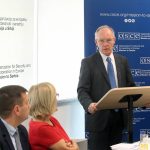
Judges and public prosecutors examined administrative, civil and criminal law mechanisms for environmental protection through examples from domestic practice, including the case known as “Gondola” and relevant case law of the Higher Court in Belgrade. Prof. Dr Luc Lavrysen, Professor and Judge of the Constitutional Court of Belgium, presented comparative experiences concerning specialised environmental courts and different models of judicial specialisation.
The discussion distinguished between institutional specialisation, involving the establishment of dedicated courts, judicial panels or divisions, and functional specialisation, pursued through continuous training, professional networks of judges and prosecutors, and the assignment of cases to practitioners with relevant knowledge and experience. Participants considered the advantages and limitations of these models in light of complex factual issues, the need to understand scientific and expert evidence, and the requirement to provide timely and effective legal protection.
The participants concluded that improving the handling of environmental cases requires the continuous specialisation of judges and public prosecutors, as well as a stronger presence of environmental law in university legal education and professional training programmes. The experience of the Environmental Law Clinic was presented as an example of connecting legal education with practical environmental protection challenges. The findings of the round table informed the further development of JMC EECL programmes and partner initiatives aimed at strengthening judicial capacity.