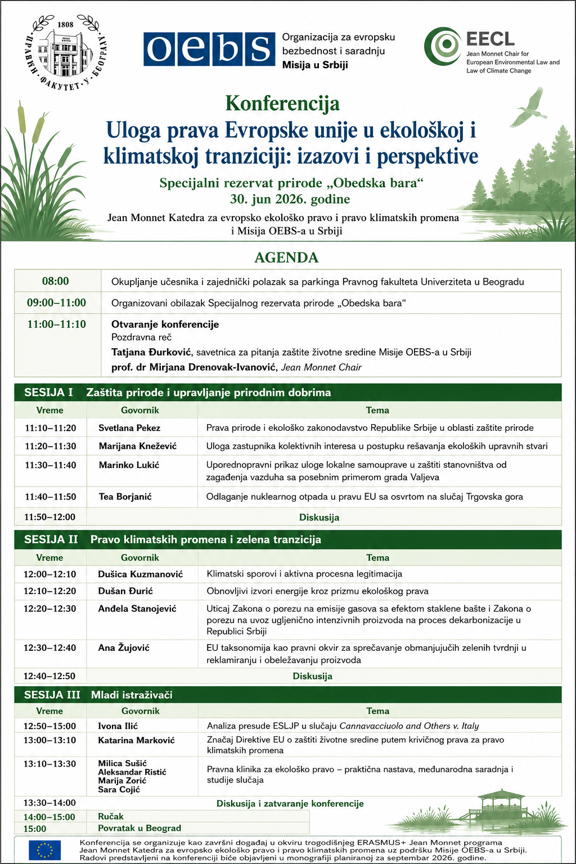

Final Conference of the Jean Monnet Chair Held at the “Obedska bara” Special Nature Reserve
The closing event of the three-year programme brought together nature protection, climate change law, the green transition and the work of young researchers.
The final conference of the three-year Erasmus+ Jean Monnet Chair in European Environmental and Climate Change Law (JMC EECL), entitled “The Role of European Union Law in the Environmental and Climate Transition: Challenges and Perspectives”, was held at the “Obedska bara” Special Nature Reserve on 30 June 2026. The conference was organised by the University of Belgrade Faculty of Law with the support of the OSCE Mission to Serbia.
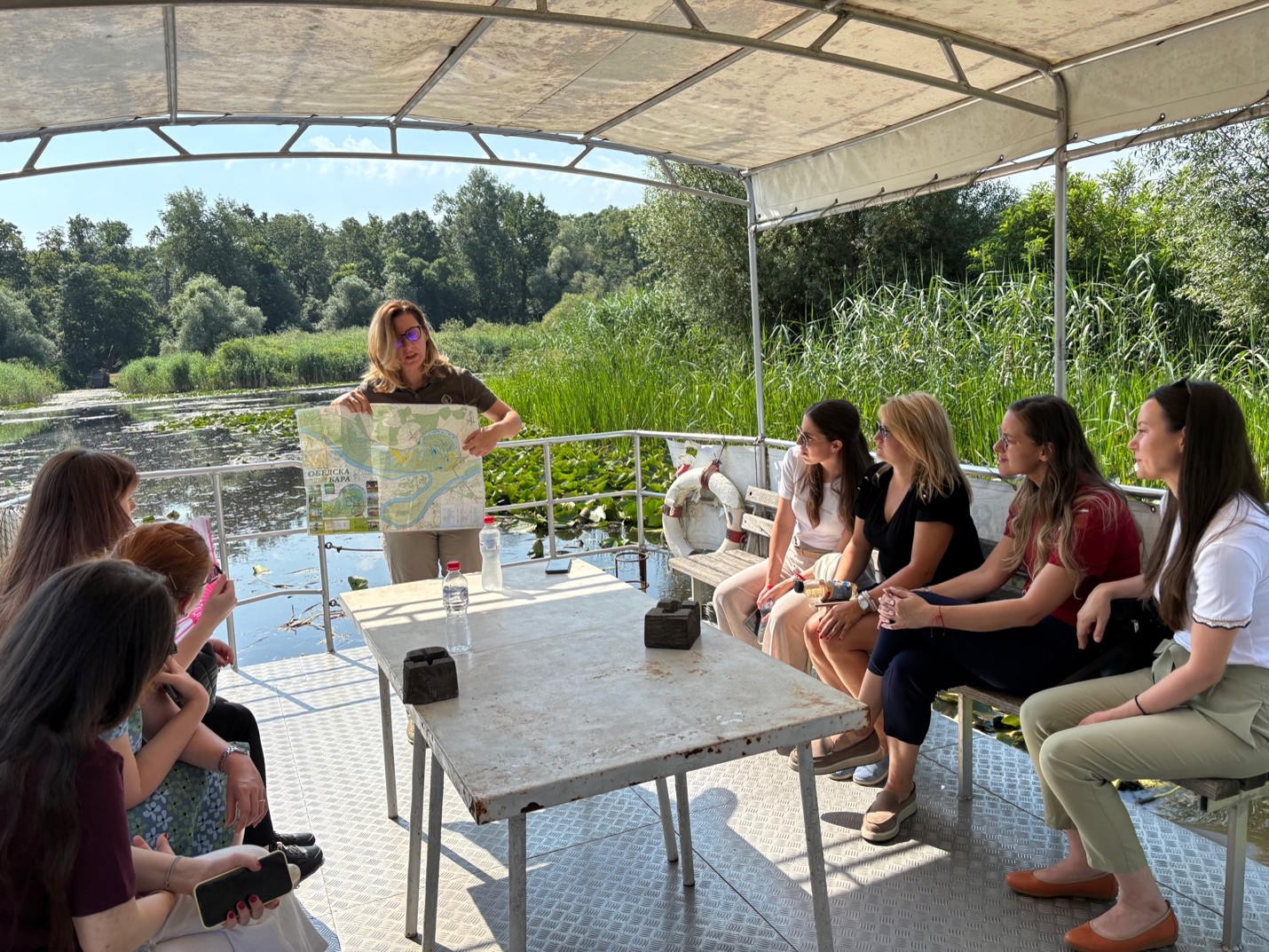
The conference was opened by Tatjana Đurković, Environmental Affairs Adviser at the OSCE Mission to Serbia, and Prof. Dr Mirjana Drenovak-Ivanović, Jean Monnet Chair holder. A guided visit to the “Obedska bara” Special Nature Reserve, organised before the working sessions, enabled participants to consider nature protection and protected-area management in their immediate practical context.
The programme was organised into three thematic sessions. The first session, devoted to nature protection and the management of natural resources, addressed the rights of nature, representation of collective interests in environmental administrative matters, the role of local self-government in protecting communities from air pollution, and the European Union legal framework for radioactive waste management, with reference to the Trgovska Gora case.
The second session focused on climate change law and the green transition. The presentations examined climate litigation and standing, the use of renewable energy sources, the impact of domestic tax instruments on decarbonisation in the Republic of Serbia, and the role of the EU Taxonomy in preventing misleading green claims.
The third session was devoted to early-career researchers. It included analyses of recent case law of the European Court of Human Rights, the relevance of the new European Union Directive on the protection of the environment through criminal law for climate change law, and the results of the Environmental Law Clinic’s work on practical legal education, international cooperation and the development of case studies.
The conference brought together professors, teaching associates, researchers, judges, lawyers and students who had participated in the teaching, research and professional activities of the Jean Monnet Chair. Contributions developed from the conference presentations are being prepared for publication in the scientific monograph “European Union Law in the Environmental and Climate Transition: Challenges and Perspectives”.