
 Representatives of Collective Interests in Recent Domestic Case Law and the Jurisprudence of the European Court of Human Rights
The two-day seminar connected domestic administrative and civil case law with emerging European Court of Human Rights standards on standing, collective interests and access to environmental and climate justice.
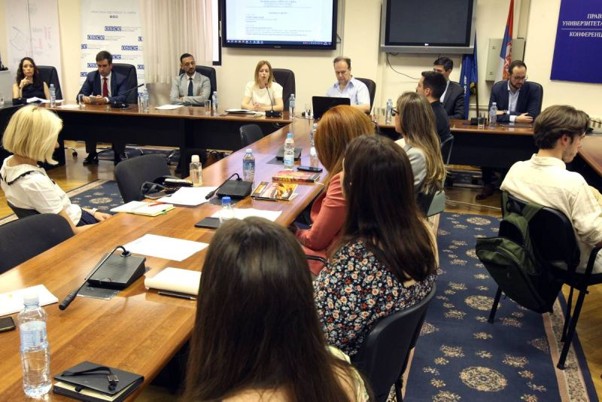
On 10 and 11 June 2024, the Jean Monnet Chair in European Environmental and Climate Change Law at the University of Belgrade Faculty of Law organised a two-day seminar in the Faculty Conference Room in cooperation with the OSCE Mission to Serbia. The programme ran from 17:00 to 19:45 on the first day and from 17:00 to 19:30 on the second. The seminar was held within the Environmental Law Clinic Hub (E-L-C Hub), a platform connecting alumni of the Environmental Law Clinic and the master’s programme in environmental law with legal professionals working in environmental protection.
The event was opened by Vladimir Valdes Garcia, Head of the Democratisation Department of the OSCE Mission to Serbia. In the introductory presentation, Prof. Dr Mirjana Drenovak-Ivanović examined representatives of collective interests in recent European Court of Human Rights case law. Particular attention was given to Eólica de S. Julião v. Portugal, Cangi and Others v. Türkiye and Verein KlimaSeniorinnen Schweiz and Others v. Switzerland, which raise questions concerning procedural rights, the standing of associations and the relationship between individual and collective interests in environmental and climate litigation.
On the first day, Judge Nebojša Đuričić discussed the actio popularis approach to environmental protection, while Judge Nikola Kitarović examined the standing of representatives of collective interests in administrative proceedings and judicial review. Hristina Vojvodić, Senior Legal Adviser at RERI and an Environmental Law Clinic alumna, presented the role of associations and organisations in protecting collective and wider public interests. Lawyer and PhD candidate Milan Dakić analysed public participation in building-permit proceedings and recent case law, while Clinic alumnus and environmental-law master’s student Veljko Milošević addressed new challenges in public information and consumer protection.
The second day was devoted to collective actions in environmental law and was led by Assistant Professor Branka Babović Vuksanović. The discussion considered procedural avenues for situations in which harm to an individual does not fully reflect interference with a public or collective interest, as well as the relationship among civil-law mechanisms, administrative judicial review and human-rights protection.
Particular attention was given to recent Serbian case law. The seminar considered the first successful actio popularis case in which an environmental organisation was recognised as having standing and obtained an order prohibiting an energy company from exceeding total maximum annual sulphur-dioxide emissions. It also examined case law on the standing of organisations in building-permit disputes, protection from excessive noise, environmental protests and the protection of cultural property.
The seminar enabled judges, lawyers, academics, Clinic alumni and young legal professionals to compare different forms of collective protection and assess their importance for effective access to justice. The materials and discussions were used to update JMC EECL teaching on the Aarhus Convention, standing, climate litigation and collective-interest protection, as well as the practical work of the Environmental Law Clinic.