 Inter-Regional Advanced Training Course on Nuclear Law at the University of Belgrade Faculty of Law
The two-week programme brought together 43 participants from 37 countries for an advanced exchange of knowledge on international and national nuclear law.
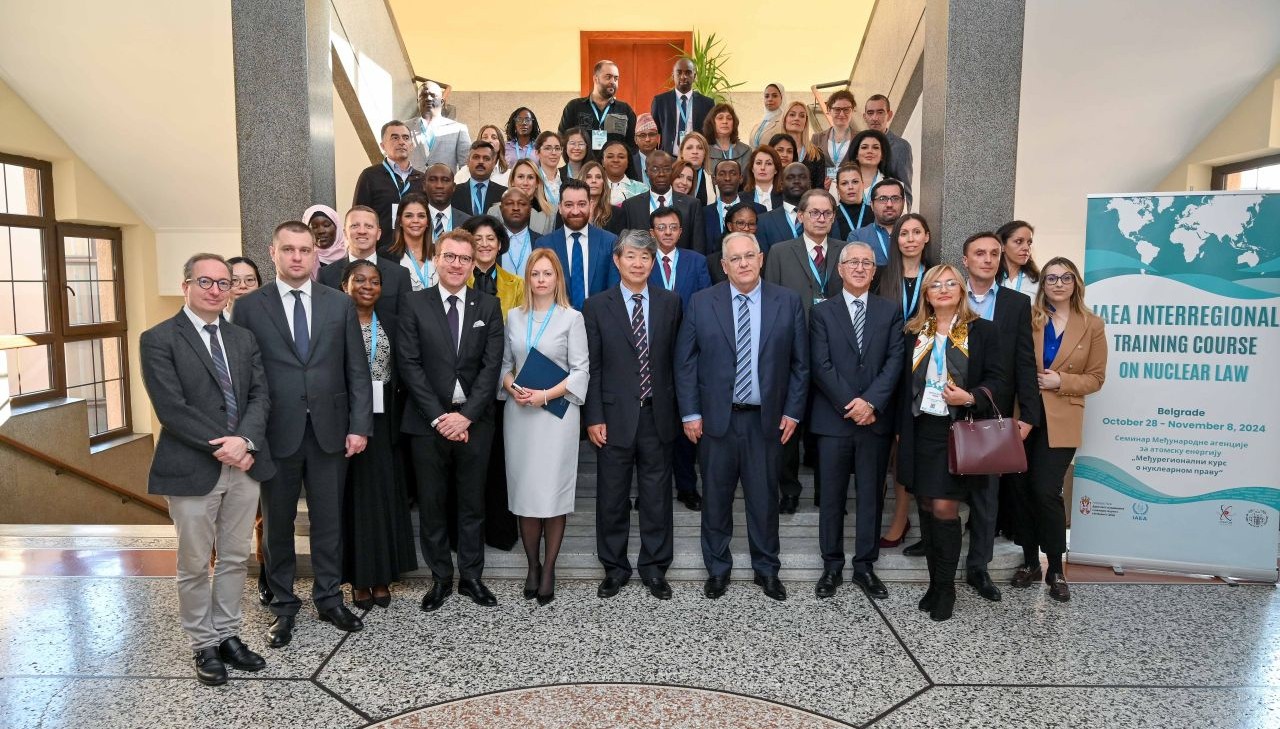
The Inter-Regional Advanced Training Course on Nuclear Law was held at the University of Belgrade Faculty of Law from 28 October to 8 November 2024. The programme was developed by the International Atomic Energy Agency (IAEA) and delivered in cooperation with the Serbian Radiation and Nuclear Safety and Security Directorate (SRBATOM), with the Faculty of Law serving as host and organisational partner.
The course was attended by 43 participants from 37 countries who had previously completed training at the IAEA Nuclear Law Institute. During the two-week programme, participants deepened their knowledge of international and national nuclear law, gained more detailed insight into different domestic legal frameworks and exchanged experience concerning challenges in their further development.
The opening ceremony was addressed by Hua Liu, IAEA Deputy Director General, Slađan Velinov, Director of SRBATOM, and Prof. Dr Mirjana Drenovak-Ivanović. The speakers emphasised that the programme was intended to support effective knowledge transfer and strengthen the capacity of institutions and governments to address complex nuclear-law questions amid changing and tense international conditions.
The course followed cooperation between the Faculty and the Directorate which, within approximately eighteen months of their first meeting, led to the conclusion of a cooperation agreement and established a basis for joint activities. Partnership with the IAEA enabled the Faculty of Law to connect its existing teaching and research capacity with an international programme of advanced professional training.
The opening address presented the Faculty’s resources in environmental law, climate change law and sustainability law, including programmes developed through two Jean Monnet Chairs and cooperation with the Directorate, the OSCE Mission to Serbia, European Union institutions, civil-society organisations and public authorities. It also highlighted that students had already prepared master’s theses connecting environmental and nuclear law.
The international character of the course enabled comparison of national regulatory models and consideration of international standards on safety, security, liability and radioactive-waste management. The course was not an activity financed or independently organised by JMC EECL. However, its delivery at the Faculty and professional exchange with the IAEA and SRBATOM contributed to the institutional environment in which the new master’s course syllabus in Nuclear Law was developed.
