
 What Does It Mean to Practise Sustainability Law?
The student colloquium combined a panel discussion with practical workshops to present sustainability law through concrete professional roles and scenario-based cases.
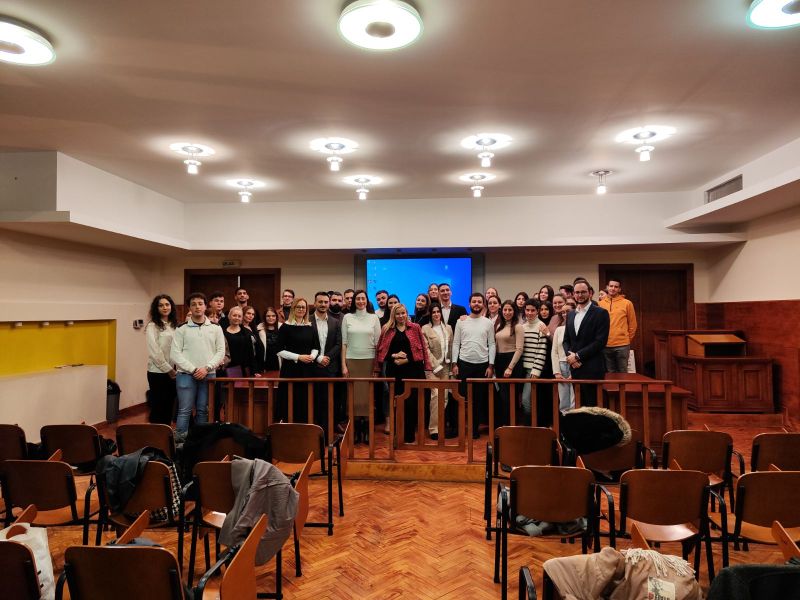
On 4 December 2024, the Jean Monnet Chair in European Environmental and Climate Change Law at the University of Belgrade Faculty of Law organised the student colloquium “What Does It Mean to Practise Sustainability Law?” in cooperation with the OSCE Mission to Serbia. The programme was held from 17:00 to 20:30 in Lecture Hall VIII, the Faculty’s courtroom, within the Environmental Law Clinic Hub (E-L-C Hub).
The colloquium brought together more than 60 students and consisted of two parts. The panel presented sustainability law as an interdisciplinary field connecting environmental law, climate change law, business law, insurance, criminal-law protection, civil-society activity and corporate governance. Its purpose was to help students understand the need for lawyers who can identify environmental and climate risks and incorporate them into legal advice and decision-making.
The panel consisted of Prof. Dr Mirjana Drenovak-Ivanović, Prof. Dr Nataša Petrović Tomić, lawyers Nina Nicović and Predrag Džamić, and trainee lawyer Veljko Milošević. Prof. Dr Nataša Petrović Tomić presented environmental and climate risks in insurance, the role of insurance companies in financing sustainable projects and their contribution to the green transition.
Nina Nicović discussed criminal-law protection within sustainability law, SLAPPs as a means of exerting pressure on activists and civil-society organisations, and possible legal responses to protect the public interest. Predrag Džamić analysed the influence of civil society on the creation, implementation and oversight of sustainability frameworks and cooperation among lawyers, civil-society organisations and institutions. Veljko Milošević examined environmental law as a basis for sustainable business, corporate responsibility, the market benefits of compliance and the application of ESG standards.
In the second part of the programme, the students were divided into four groups, with each workshop led by a panellist. The groups worked on scenario-based cases, identified relevant facts and legal sources, considered the interests of the parties involved and formulated possible legal solutions. Their conclusions were presented in a joint closing session, after which certificates were awarded to the participants.
The interactive format connected students with academics and legal professionals working on sustainability matters. The scenario-based work directly contributed to the development of practical JMC EECL teaching materials, the strengthening of clinical legal education and preparation of the new master’s course Environmental Law in Practice.